How the rabbit hole works. Start with anything that grabs you, say UFOs. Every person, place and document a page mentions links to its own page, so a UFO file leads to a witness, the witness leads to the people who investigated the case, and it keeps going.
The path you take shows in the bar under the top menu on every page, so you can step back any time or climb out and start again.
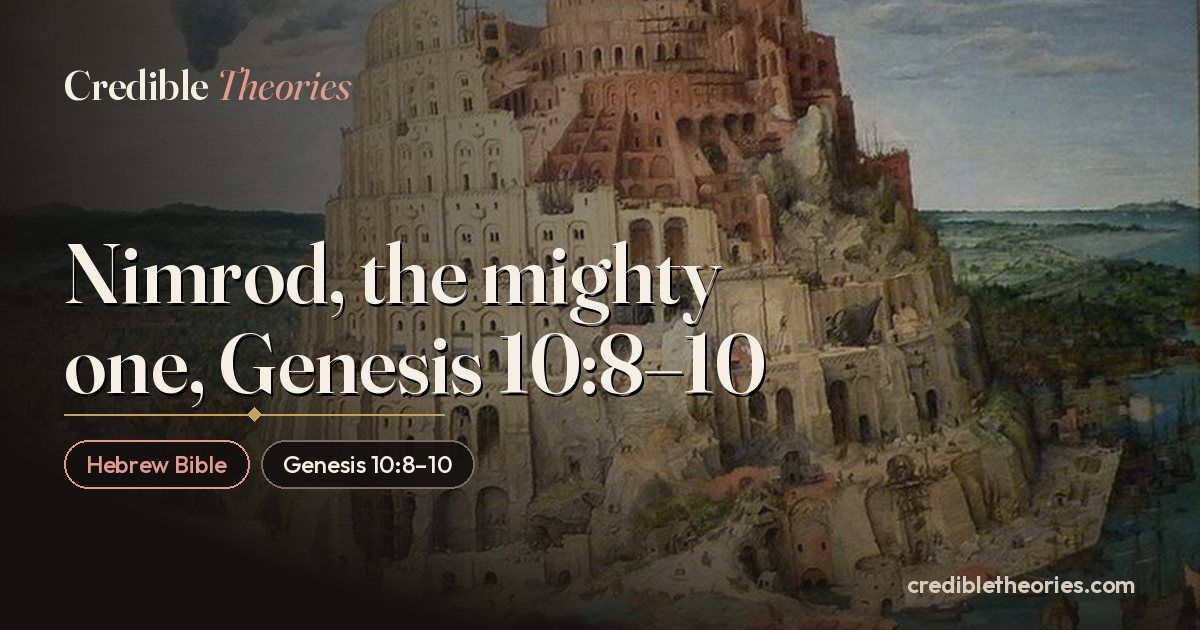
This is a short passage from Genesis, the first book of the Bible, likely written around 900 to 500 BCE. Set after the Flood, it says Nimrod, a son of Cush, "began to be a mighty one" and was a mighty hunter, and his kingdom began at Babel. The Hebrew word for "mighty one" is gibbor, the same word used earlier in Genesis 6:4.
ReferenceGenesis 10:8–10
Writtenc. 900–500 BCE
SetAfter the Flood
And Cush begat Nimrod: he began to be a mighty one in the earth. He was a mighty hunter before the LORD… And the beginning of his kingdom was Babel.
Documented · Ancient text, c. 900–500 BCE Translation: KJV
AdvertisementAd space
Read it literally
'He began to be' a gibbor: he became one, he was not born one. A human who turned himself into a hybrid, then founded Babel.
What scholars say
'Mighty one' is gibbor, the same word used for the Nephilim's children in Genesis 6:4. Often linked to a Mesopotamian king or the god Ninurta.
Babel is the famous one, but Babylonians, Greeks, the Quran, Mexico, China and the Zambezi all tell of people trying to build or climb their way up to the gods, and failing.
Genesis 11 (Babel) is one telling. The same story is told 7 more times, in 5 parts of the world. Follow it:
The open question: Is the tower story about one real building, about pride, or about why people speak different languages? Join the debate
Questions people ask about Genesis 10:8–10
What cities did Nimrod found in Genesis?
Genesis 10 says his kingdom began with Babel, Erech, Accad and Calneh in the land of Shinar, meaning southern Mesopotamia. From there he, or in some readings Asshur, built Nineveh, Rehoboth-Ir, Calah and Resen in Assyria. Erech is the city of Uruk. The ruins of Calah are still known locally as Nimrud.
Did Nimrod build the Tower of Babel?
Genesis does not say so. The idea comes from later tradition. The Jewish historian Josephus, writing in the first century, says in his Antiquities of the Jews that Nimrod stirred people up to defy God and led the building of the tower. Many later Jewish and Christian retellings followed him.
Who is Nimrod in Islamic tradition?
The Quran, Surah 2:258, tells of an unnamed king who argued with Abraham, claiming he too could give life and cause death. Muslim commentators identify this king as Nimrod, called Namrud. Tradition also says he had Abraham thrown into a fire, which Surah 21:69 says God made cool and safe for him.
Used on these files
Nephilim: Who Were the Giants of Genesis 6?Myth or legendGenesis says giants walked the earth "also after that," meaning after the Flood that was meant to wipe everything out. The Nephilim get just two verses in the whole Hebrew Bible, and neither explains them. Who were they, and how did they outlast the Flood? Scholars and the text itself disagree.
Nimrod: Who Was the Mighty Hunter Before the Lord?Myth or legendGenesis uses the same word for Nimrod, "mighty one," that it uses for the offspring of the sons of God, and the Greek Bible calls him a giant. He is the Bible's first empire-builder, and legend made him the force behind the Tower of Babel. Most scholars see a memory of Mesopotamian kings. Who was he really?
Ninurta: The Warrior God Who Put the Stones on TrialMyth or legendAfter defeating an army of living stones, the warrior god Ninurta holds a trial of rocks, pronouncing a different fate on each kind of stone for how it behaved in the war. His weapon can talk, too; scholars read the myth as floods, mountains and irrigation dressed up as battle. What does a verdict on stones sound like?
Where this comes from
EvidenceDocumented
Comes fromThe Book of Genesis, Genesis 10:8–10, read here in the King James Version. The first book of the Bible, telling of Creation, Adam and Eve, Noah's Flood and the families of Abraham, Isaac and Jacob. Scholars think it was written and edited over several centuries and finished by roughly 500 to 400 BC. The oldest surviving copies are pieces of the Dead Sea Scrolls.
What this means
The text exists and is quoted from a published translation. What it describes is a separate question.
Primary records exist: an original document, a published text, an official file or a dated report. We link to them. This level says the record exists and what it says, not that every claim in it is true.
The King James BibleThe English Bible made for King James I and first printed in 1611; the wording most people know comes from a 1769 update. It is out of copyright, which is why we quote it. The 1611 printing also had the Apocrypha, extra books kept in Catholic and Orthodox Bibles.King James Version (1611; standard 1769 text), with ApocryphaPrimary textArchived copy, 2026-10-03
The Book of GenesisThe first book of the Bible, telling of Creation, Adam and Eve, Noah's Flood and the families of Abraham, Isaac and Jacob. Scholars think it was written and edited over several centuries and finished by roughly 500 to 400 BC. The oldest surviving copies are pieces of the Dead Sea Scrolls.Genesis 6:1–4, King James VersionOnline copyPrimary textArchived copy, 2026-10-03
Lugal-e (The Exploits of Ninurta)A long Sumerian poem about the warrior god Ninurta, who defeats a monster called Asag with help from his talking weapon, Sharur. It was copied for well over a thousand years, from about 1900 BC on, later with a Babylonian translation line by line.The Exploits of Ninurta (Lugal-e), ETCSL t.1.6.2, University of OxfordPrimary textArchived copy, 2026-09-06
Scholarly dates are rounded. The wording follows the named public-domain translation.
More from Hebrew Bible
The story before and after this one, and what each shares with Nimrod, the mighty one.