How the rabbit hole works. Start with anything that grabs you, say UFOs. Every person, place and document a page mentions links to its own page, so a UFO file leads to a witness, the witness leads to the people who investigated the case, and it keeps going.
The path you take shows in the bar under the top menu on every page, so you can step back any time or climb out and start again.
This is a summary from the Book of Jasher, a Hebrew book that retells Bible history with added Jewish legends. It was first printed in 1625, likely from medieval times, and put into English in 1840. It says people before the Flood taught animals of one kind to mate with another kind, which corrupted the earth. It is not the lost book of Jasher named in Joshua.
ReferenceBook of Jasher 4:18
WrittenHebrew printed 1625, likely medieval; English 1840
SetBefore the Flood
The book says the people before the Flood took animals of one kind and taught them to mix with another kind, corrupting the earth.
It was published in New York by Mordecai Manuel Noah, a well-known Jewish American journalist and politician, together with A. S. Gould. The translator was not named at the time. He was later identified as Moses Samuel of Liverpool, who had sold his translation to Noah in 1839.
Where does the Bible mention the book of Jasher?
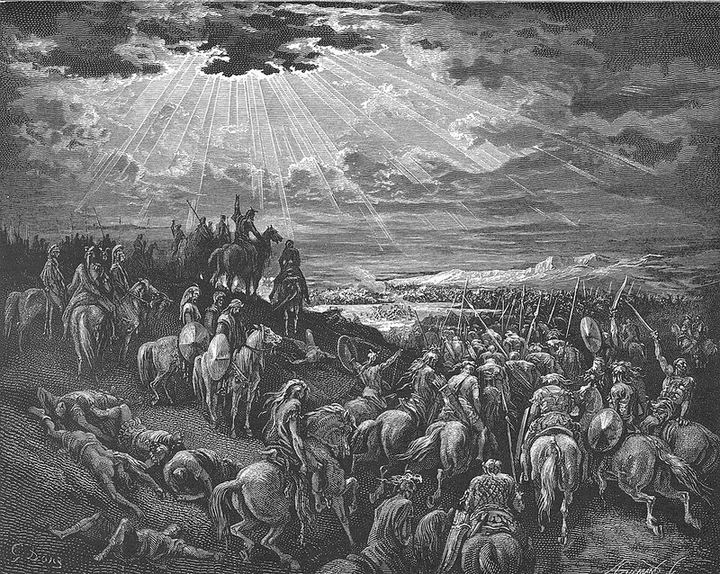
Two verses cite it. Joshua 10:13 uses it as the source for the sun standing still, and 2 Samuel 1:18 points to it for David's lament over Saul and Jonathan. The name is usually translated 'Book of the Upright'. That ancient book is lost, and the printed Book of Jasher is a much later work.
Are there different books called Jasher?
Yes. Besides the Hebrew Sefer haYashar printed in 1625 and translated in 1840, an English book called The Book of Jasher appeared in 1751. Its publisher, Jacob Ilive, claimed it had been translated by the medieval scholar Alcuin. Scholars treat that 1751 book as a fabrication, and it tells a very different story.
Used on these files
Book of Jasher: Is It the Lost Book the Bible Mentions?DocumentedThe Bible twice cites a lost book of Jasher, and in 1625 a book by that name was printed in Venice. It claims to be rescued from Jerusalem's ruins, yet scholars date it to the medieval period. Here Nimrod's hunting power comes from Adam's own garments, which made animals kneel to whoever wore them. What else is in it?
The Watchers: Who Were the Fallen Angels of Enoch?Myth or legendThe story says some angels who never sleep came down to a real mountain summit, picked up human wives, and taught people metalworking, spells and astronomy. Their leaders are named, each in charge of ten others. The same word shows up in the Book of Daniel as a heavenly council. So who exactly were the Watchers?
Where this comes from
EvidenceDocumented
Comes fromThe Book of Jasher (1840 English edition), Book of Jasher 4:18, read here in the M. M. Noah. A Hebrew book that retells Bible history from Adam to the Judges, adding many Jewish legends. It was first printed in Venice in 1625.
What this means
The text exists and is quoted from a published translation. What it describes is a separate question.
Primary records exist: an original document, a published text, an official file or a dated report. We link to them. This level says the record exists and what it says, not that every claim in it is true.
The Book of Jasher (1840 English edition)A Hebrew book that retells Bible history from Adam to the Judges, adding many Jewish legends. It was first printed in Venice in 1625. It is not the lost 'Book of Jasher' the Bible mentions; scholars think it was written in the Middle Ages or later. An English translation came out in New York in 1840.M. M. Noah (publ.), The Book of Jasher (1840)Primary textArchived copy, 2026-10-03
The Book of Enoch (1 Enoch)Jewish writings about Enoch, Noah's great-grandfather, the oldest parts from about 300 to 200 BC. It tells of angels called Watchers who came down to earth. Full copies survived only in Ethiopia, whose church still counts it as scripture. Pieces in Aramaic were found among the Dead Sea Scrolls in 1952.1 Enoch 6–8, trans. R. H. Charles, The Book of Enoch (1917)Online copyPrimary textArchived copy, 2026-09-03
Scholarly dates are rounded. The wording follows the named public-domain translation.
More from Enoch, Jubilees and others
Two more stories, and what each shares with The Book of Jasher: hybrids of animals.